For logistics managers operating in today’s rapidly evolving supply chain landscape, efficiency is the currency of success. As a result, the market demands speed, accuracy, and cost-effectiveness, pushing traditional load-matching methods to their breaking point. That’s why the solution lies not just in better data, but in smarter decision-making powered by Artificial Intelligence (AI).
AI-powered freight matching is fundamentally changing how loads are connected with capacity. Instead of relying on basic search-and-filter functions like older load boards, it delivers predictive, dynamic matches that optimize each step of the transportation process. In other words, it helps teams make better decisions faster. Because of this, it’s critical for freight brokers to understand and apply, and equally essential for logistics managers looking to gain a competitive edge.
The Limitations of Traditional Matching
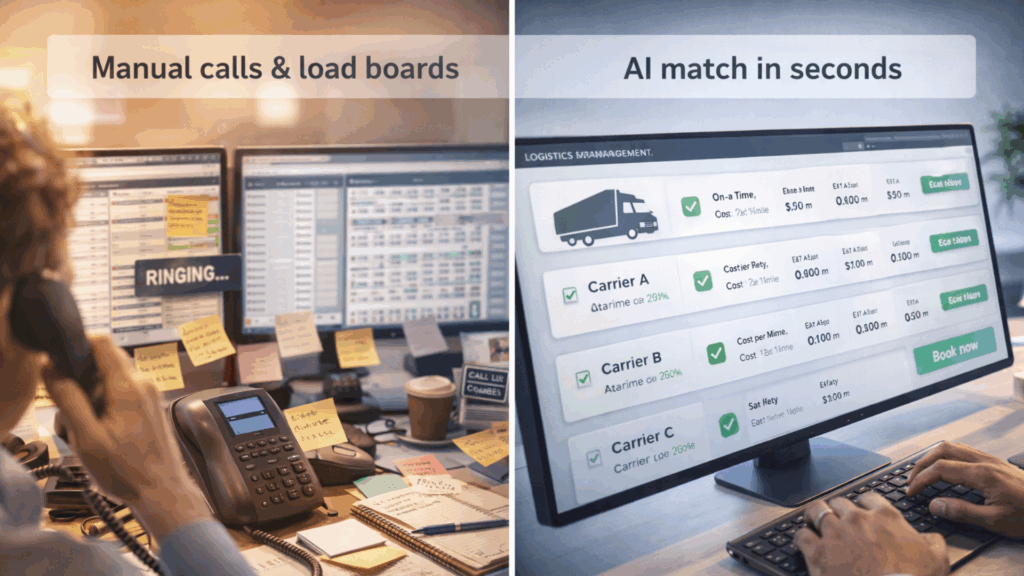
Historically, matching a load to a truck involved a labor-intensive process. Freight brokers would spend hours making calls, sifting through load boards, and manually negotiating rates for logistics managers. This method is slow, prone to human error, and often results in sub-optimal pairings, as loads might sit idle, or carriers might deadhead long distances, wasting time and fuel. In a just-in-time environment, these delays translate directly into higher costs and reduced customer satisfaction.
How AI Elevates the Matching Process
AI tools, utilizing machine learning algorithms, ingest and process vast datasets far beyond human capability. They consider real-time and historical data points simultaneously, including:
- Carrier Preferences and History: Understanding a carrier’s preferred lanes, equipment type, operating hours, and historical reliability.
- Real-time Capacity: Utilizing telematics and ELD data to know the exact location and status of available trucks.
- Predictive Pricing: Analyzing market fluctuations, fuel costs, and lane history to instantly generate dynamic, fair-market rates, reducing negotiation time.
- Optimization of Routes: Considering weather, traffic patterns, and regulations to calculate the fastest and most fuel-efficient route for a specific pairing.
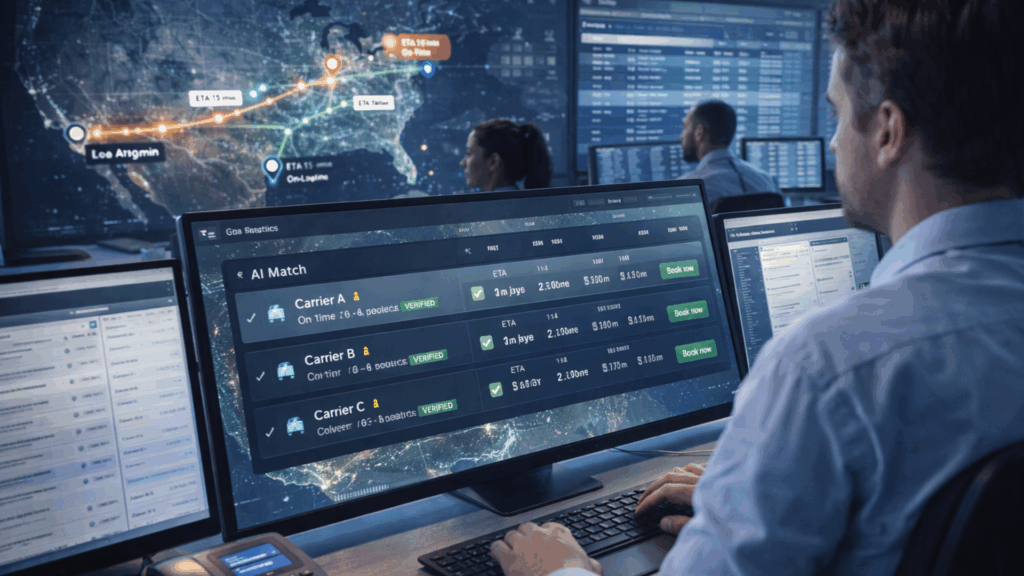
This comprehensive analysis allows AI to surface the best possible match, meaning the right truck, at the right time, for the right price, in seconds, not hours. For Go To Truckers’ freight brokers, this means a more efficient service, and for logistics managers, a significant reduction in empty miles, improved on-time delivery rates, and better utilization of their transportation budget.
The Importance of the Freight Broker
While the technology is advanced, it is essential to recognize the crucial role of the human element, specifically Go To Truckers’ freight brokers. AI is a powerful tool, but it is not a replacement for expertise. Go To Truckers’ freight brokers remain the key person for the progress of freight, acting as the intelligent interface between technology and execution.
The broker’s value proposition is amplified, not diminished, by AI:
- Strategic Oversight: AI identifies the possible best matches; Go To Truckers’ freight brokers validate the practical best matches by applying their deep market knowledge to handle exceptions, vet new carriers, and ensure compliance.
- Relationship Management: Transportation is a relationship business. Go To Truckers’ freight brokers maintain the personal trust and communication with both shippers and carriers, handling the complex human-centric aspects of freight movement that an algorithm cannot replicate.
- Conflict Resolution and Crisis Management: When a disruption occurs, such as a breakdown, a sudden change in priority, or a severe weather event, Go To Truckers’ freight brokers leverage their experience to find creative solutions and ensure the load still moves, something AI can only flag.
- Negotiation and Market Insight: While AI sets the initial rate, Go To Truckers’ freight brokers use their negotiation skills and real-time feel for the market to finalize profitable deals and nurture long-term partnerships.
For logistics managers, partnering with AI-enabled freight brokers means they get the best of both worlds: the speed and accuracy of machine learning combined with the strategic judgment and relationship intelligence of a seasoned professional.
Looking Ahead
Implementing AI-powered systems is no longer a futuristic goal; it is a current necessity. Logistics managers must prepare their operations by integrating these platforms and fostering a culture where brokers and planners use AI as an indispensable tool. The future of freight success depends on leveraging these intelligent systems to maximize efficiency and maintain a high standard of reliability. By doing so, the industry can finally move beyond the manual grind and realize truly optimized supply chain performance.
If your team is considering AI-enabled freight workflows, our website has more content that breaks down the “how” behind smarter matching, visibility, and execution—so you can turn the tech into real results.
No Comments yet!