Freight brokers are becoming increasingly essential as the U.S. logistics landscape enters a firmer phase than in previous years, marked by intense capacity pressure and escalating operating costs. As a logistics manager, this environment creates a significant hurdle for you, as spot rates and expenses rise in tandem. A primary concern is fuel costs; with diesel prices exceeding $5.50 per gallon, small carriers and owner-operators are facing a disproportionate financial burden..
This financial pressure has direct operational consequences. Some analysis indicate that many small carriers are reacting by driving fewer miles and becoming increasingly selective about the routes and loads they accept, often rejecting low-margin freight to protect their bottom line. During high-impact events like International Roadcheck Week, this capacity crunch is magnified, typically resulting in a temporary reduction in available equipment and potential spot rate increases of 6% to 8%.
In this volatile environment, the freight broker transitions from a transactional necessity to a strategic partner, particularly in the complex Southwest US corridor. Achieving efficiency in the Southwest; a region defined by vast distances, extreme heat, and dense urban congestion, requires more than standard algorithms. A specialized broker acts as an optimization engine, leveraging real-time market intelligence and technology to maintain supply chain resilience.
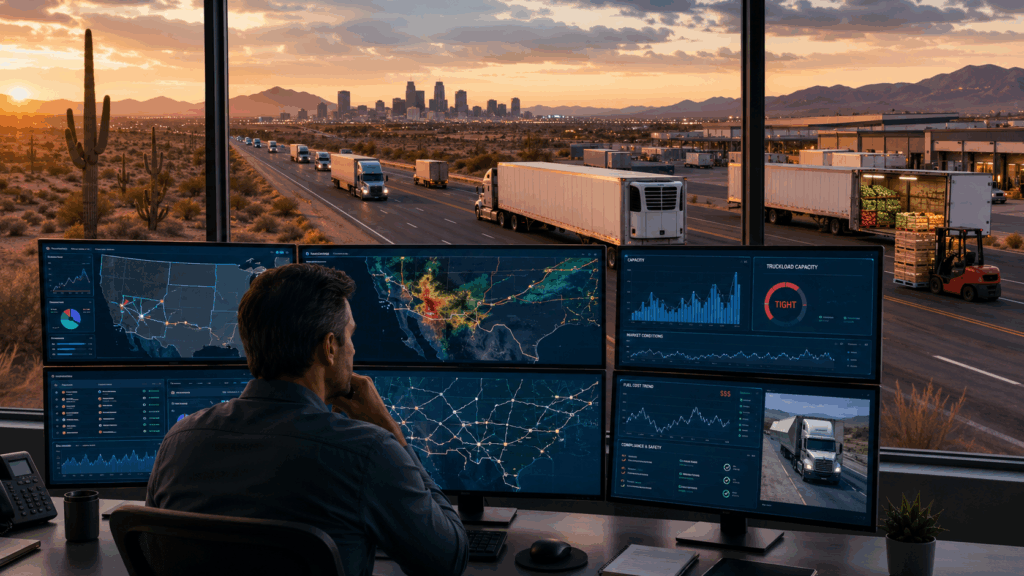
First, brokers provide indispensable real-time capacity control. Because they maintain vast, vetted networks of carriers, which include smaller partners who may not list on public load boards. Here’s where brokers can source reliable equipment even when market capacity is tight. This is critical during regional harvest surges or when primary carriers reject tenders due to rising costs.
Second, brokers offer advanced route intelligence. Utilizing sophisticated Transportation Management Systems (TMS), they move beyond static mapping to provide predictive routing. This includes analyzing historical data to bypass known bottlenecks, monitoring weather patterns to avoid desert heat that affects vehicle performance, and identifying “hidden” backhaul opportunities that significantly reduce empty miles and overall landed costs.
And finally, the broker is a vital buffer for compliance and risk mitigation. They provide automated due diligence by continuously monitoring carrier insurance, safety scores, and ELD compliance. This oversight is especially critical for temperature-sensitive produce and cross-border freight, where adherence to the Food Safety Modernization Act (FSMA) and complex customs regulations is mandatory to prevent spoilage and costly legal issues. By partnering with a technology-driven broker, logistics managers secure a resilient operation capable of weathering the market’s firmer cycles while protecting their bottom line.
The firmer phase is just that; a phase. At Go To Truckers we can help you navigate the full spectrum. Let’s schedule a discussion with a Go To Truckers’ manager to analyze how these market phases affect your specific lanes and explore collaborative solutions for optimizing your logistics: Luis Montes Business Development ✉️l.montes@gototruckers.com
📞312-428-9542 🌐 https://gototruckers.com/
No Comments yet!